I've taken down my serial novel, Fields without Fences, for professional reasons. I hope to publish it in revised for-realsies form at some point and this, as you might imagine, is a necessary step. Thanks to all who read it
You can buy my actually published books here:
The Extreme Life of the Sea
Blood Plagues and Endless Raids: A Hundred Million Lives in the World of Warcraft
Tuesday, August 1, 2017

Friday, August 24, 2012
Bayonetta rules and you should care

http://thinkprogress.org/alyssa/2012/08/24/739221/bayonetta/
Wednesday, July 25, 2012
In Defense of Boredom
 | |
| "This beats the shit out of FarmVille." |
Note: This post contains anecdotes about my personal life, and not many jokes. Both these things are atypical of the I Drop Things experience most loyal readers have come to expect. Sorries plural.
"You have to learn to entertain yourself."
These might be the most-repeated sentence spoken by my parents during my childhood. It's certainly up there with "Your dad's ponytail gets me so hot" and "Nobody can ever know Lauren was adopted." (Sorry, Sis! Ripping the Band-Aid off! You should have known when nobody else was blond!) Children are bored a lot. Part of this is an abundance of energy, but honestly most of it is the lack of freedom. You can't do what you want whenever you want: something I have to occasionally remind myself is AMAZING about adulthood.
Adults do things they don't want to do, but it's all in the service of other things we enjoy. I didn't want to get up early this morning, pick up my girlfriend from the auto shop and take her back home. But I did these things, because I like my girlfriend. I got to make a decision, and spice up that decision with blasting heavy metal in my car and detouring to get McDonald's breakfast. So adult errands feature the following bonuses: 1) you are doing this for a reason, 2) you get to drive, 3) Mickey D's whenever you goddamned want it. Which for me isn't often, but the freedom to make decisions is really the point.
As a child, you don't get to make decisions. Errands were always the worst, and I remember getting furious when my parents would tack on extra stops. "Mom, I have budgeted only enough surly attitude for the grocery store and the post office. The gas station I could manage, but only because you let me pump. But this right here, this hardware store? This is BULLSHIT. You won't even let me come inside because of the nail-throwing incident! They were shitty darts, Mom. I figured that out pretty quick. It's done." I wasn't quite so eloquent at the time; nor was I allowed to say "shit" in front of my parents. But you get the idea, and if you're over the age of 20 this was your childhood too. There was a lot of time sitting around bored, especially during the summer. My summer days were spent at the marine lab where my dad worked, and the park adjacent to it. It was so boring I'd actually look forward to school starting again. As a 10-year-old, what do you do for six hours a day by yourself? And how much value is there in children entertaining themselves?
 |
| "Thank God we don't have to talk to each other anymore." |
Since that incident, I've been keeping an eye out for children playing on cell phones. Turns out, it's everywhere. Grocery stores are the worst; kids trudge like zombies down the aisles in the metal cart's wake, narrowly avoiding collisions with other patrons. Kids are just absorbed with smart phones. This isn't a criticism of the child. I had a Game Boy as a kid, and if that thing had been around all the time (like a phone) it would have been my whole life. It's not even a criticism of the parent, who just wants her kid to shut up and behave for twenty minutes. My parents sent us on "missions" around the store to find items from a list. It probably didn't save any time, but it got two children out of their hair. Smart phones are the easiest way to distract your obnoxious whelps, so that's what you use. I think the latest wave of games should get some blame on their own; the free-to-play model dominating the mobile market doesn't lend itself to exploratory games. When I was a kid, we sat down and played Monkey Island, which at least had clever jokes and forced you to think outside the box. It wasn't the click-this-do-this-get-points compulsion/reward loop that fuels modern gaming.
But I think that's limiting. I don't think our society is improved by this phenomenon--children NOT spending hours each day bored out of their skulls. If I have one complaint about human beings in the Internet Age (as if I've really lived in any other age), it's their reliance on structure. The Internet is fun, but it's structured by nature. There are buttons; you push them and a limited selection of things will happen. Video games are fun, but they're rote pursuits of set rewards: almost the definition of structure. You know what I did when I was bored without a book or TV or game system? I explored my environment for possibilities. I would find the coolest thing in the room and come up with my own games. If I was outside in Kakaako Beach Park with nothing to do and nobody to go cardboard-sledding with (there were steep grassy hills but no snow), I'd come up with elaborate space-opera stories in my head. Every day I'd add a little more to the story, always keeping it between my ears, until I had been working on them for literally years. If I had a single friend available, we'd imagine ourselves heroes in amazing circumstances, conceiving problems to solve and talking each other through the solutions. These stories and characters also lasted years. These were role-playing games without pen, paper or dice. But I can still vividly recall the details. At the post office, I'd demand a number from my dad and run off to find that particular P.O. box among the thousands lining the walls. I'd imagine far-away fantasy lands and draw out their borders with a stick in the sand.

A question with more relevance to us twentysomething without kids: do I have enough quiet moments now? When's the last time I was truly bored? Personally, I've avoided getting a smart phone to this day. My flip phone is fine for calls, and I don't want to be "connected" full-time. Everyone I know with a smart phone is constantly distracted by it. At concerts, folks are more focused on recording the show than dancing. On trains, people play Angry Beavers while I people-watch. In line at the store, fellow patrons check their texts as I imagine the cashier's life story. Do I get anything out of it? Tangibly, no. But our brains are products of the work they do; neuroplasticity is well-established. Everything we do alters the wiring in our skulls, ever-so-slightly. Mental skills must be actively cultivated if you ever hope to accomplish anything with them, and childhood is obviously crucial to human development. If a society makes its children 50% less bored, denying them hundreds of boredom events each year, it's almost by definition making them less creative. There's simply no scientific way that smart phone proliferation isn't limiting and channeling the collective human mind. LOLcats are funny, but after a thousand LOLcats it's still just a cat picture with a funny caption. There is creativity, but it's so specific and narrow and prescriptive. What's the next creative step? I know! Condescending Willy Wonka! This is the progress of human civilization? Check out this humorous .gif compared with this one. Both those people felt creative as they submitted those to a website that will keep them locked up in perpetuity, unable to be downloaded or embedded. No, they must be LINKED! To generate traffic for QuickMeme, an aggregator of other people's unpaid "creativity." This is why human civilization is doomed. We're all more interested in eating each other than building things.
Maybe this piece has seemed curmudgeonly. I don't want to dump the Internet and go back to newspapers and novels. I just want us, as a society, to acknowledge the value of boredom. To step away from being Connected and ignore our texts and e-mails for stretches every day. You don't have to immerse yourself in the real world; imagination is fine. Just do something, think of something, CREATE something that didn't exist before. And let it flit away into the air; forget about it after you're done, if you don't like it. Maybe the next one will be better. Maybe, one day, one of them will be truly amazing. The biggest creative breakthroughs I've personally had came as the ultimate results of single, idle ideas. Those ideas didn't make it, but something similar did. Dozens of I Drop Things posts originated while I was out running--ideas I never would have come up in a gym on a treadmill in front of a muted ESPN broadcast. Fuck you, Around the Horn. You are killing human civilization. It was on a run this very day that I was inspired to finally write this post; that I was able to finally put together my thoughts and articulate (helpfully rather than rantingly) why these iPhone brats bother me.

I run on a bike trail along the San Francisco Bay. it's relatively cool, little-trafficked, and the scenery is gorgeous. California poppies grow on one side, orange blooms screaming for attention. On the other is a short incline and then a long tidal shallow. The tide was out at that point, exposing drenched stinking mud for a hundred yards. Two small children, maybe eight years old, squatted at the base of the incline. Wielding plastic shovels and buckets, they dug lamely in the mud, unwilling to play with anything so foul. No adults in sight. Disappointed little faces, because they were clearly looking for critters and not finding them. I thought back instantly to my own childhood, goofing around on the beach and unsure where the cool animals hid. "Turn the rocks over!" I bellowed down to the kids. They looked up at this shirtless sweaty hairy ape and his panting dog. "All the best stuff is under there!"
They reached down and flipped a stone between them. Recoiled a step, shrieking "CRABS" as a dozen little grey-green crustaceans skittered away in all directions. I kept running, since I knew what came next and had lived it all years before. The next time you flip the stone, you're expecting the crabs and you'll try to catch one. It'll escape, but by the third stone you've learned their movements and get your fingers on one. It pinches; you howl again and drop it. But the pain fades in seconds, and the next time you try to grab the claw itself. It breaks off, along with the whole arm. Next time, a different approach. It probably took me a dozen flips to catch my first crab. The key is scooping from behind and gripping the back of its shell with fingertips, right where the egg clasp folds into the underside of its shell. Absolutely amazing. If I hadn't been bored out of my fucking mind, it never would have happened. "Let's go wallow in the mud and turn rocks over" doesn't appeal when you've got Angry Birds.
Just as responsible cat owners need to confuse the little shits, responsible parents are obliged to bore their children. They'll be a little more obnoxious, but so much more worthwhile.
Tuesday, July 17, 2012
A Stupid Idea Making a Stupid Amount of Sense
 |
| "I'm just checking for lice." |
I figured out Mitt Romney. I figured out the entire Church of Jesus Christ of Latter-Day Saints of Wealth Gospel of Excessive Prepositional Phrases. Not everyone in the church, but its highest elites. Here's my thesis: they're vampires. Mitt Romney is a high-level vampire, but not the absolute highest. This seems stupid and contrived, I know. But as the great Nick Frost once said, "It's NOT ridiculous, Dad! It's very un-ridiculous. And the more I think about it, the more un-ridiculous it all is!" There's just too many coincidences for this to be a coincidence. Let's be clear: we're not talking about classical vampires. Mitt Romney is obviously not set aflame by sunlight. Nor are other top Mormons. They're more like Twilight vampires (Stephanie Meyer is a huge Mormon. COINCIDENCE?!), lacking any weaknesses or defining traits other than otherworldly hawtness.
 |
| At his inauguration, President Romney will place his metal claw on the Book of Mormon and take the Oath of La Magra, the Blood God. |
1) Impeccably-coiffed hair, silver at the temples
2) Effortlessly handsome, nearly-ageless face
3) Vast personal wealth
4) Mysterious sons rarely seen in daylight, certainly not the scorching heat of the Middle Eastern sun fighting the wars they and their father support
5) No evidence of normal bodily functions, wearing the same pair of blue jeans day after day and never appearing to sweat
6) Devotion to Austrian economics. To be fair, every policy stance Mitt holds is just a weak-kneed capitulation to the most powerful interest group concerning that issue. But if there's one demographic who'd be down for tight money policy and no inflation at any price, it'd be vampires. Think about it: inflation hurts incumbent creditors. Who's more "incumbent" than a vampire amassing wealth over centuries of unholy dominion? Mitt's gotta be PISSED the silver dollars originally minted by Johnny Tremaine can't each buy a slave family off the docks at Norfolk.
AND NOW THE VARIOUS VAMPIRIC TRAITS OF THE LDS CHURCH:
The entire organization stands for the unification of power. Think about it: for just about every religion in human civilization, the clergy stands apart from the normal populace. They don't engage in normal business; in many faiths they're bound to vows of poverty and chastity. The essence of true religion is un-achievement: separating enlightenment from the worldly concerns looking to pollute it. I think religion is ridiculous, but if you believe so fervently you're willing to take orders then my hat's off. I don't wear hats because they interfere with my satellite-dish ears, but imagine I wore a hat and took it off to a monk. But not to offer it to him as a gift or anything, because I like my hat and, you know...poverty. Monks can't be hoarding hats off the street. That's inappropriate.
Anyway, the un-worldliness of spiritual leaders has (at the best of times) been a counterweight to tyranny and oppression. See: King, Martin Luther, before he went back in time to fight Lucifer's giant robot avatar. But in the LDS church, lay members assume the role of spiritual leaders. This might sound good in theory. In reality, the richest and most socially/economically powerful men become spiritual leaders. See: Romney, Willard Mittens, a high-ranking bishop or something in the wacky-ass hierarchy Mormons invented. So you end up with power concentrated in the hands of only a few men, who JUST SO HAPPEN to have been granted the right to take tons of wives. So these men now wield a monopoly over every type of power in society: social, economic, spiritual, and sexual. Sounds like...VAMPIRES. What do vampires do?
--They amass huge wealth, using it to insulate themselves and become unattached to normal human society. If you've ever met a Mormon man, you probably wondered "why was that interaction so weird?' Because he's been raised by vampires and is preparing himself for the cult. Incidentally, I know many Mormon women who are lovely and intelligent and completely wasted on the weirdos they will eventually marry for lack of other options. Sorry ladies, we all have to make choices.
--They amass harems of women, as young and virginal as possible, for crazy vampire blood sex. I don't really know how it works, because my tastes in pornography are pretty vanilla. Reverse cowgirl puts my needle at red, and NOT in the sexual way that sounds like. The exact opposite, in fact. And nobody should spit on anyone else, or do stuff with his/her butt.
--They build huge palaces that are at once extravagant and austere. Check out the LDS super mega space temple in San Diego--paint it black (wanted to make a Rolling Stones joke but it's too much work for such a middling band) and you've got a vampire fortress. But these are shiny sparkle vampires, so it makes extra sense that the temple would be white:

--Having built said palaces, they don't let anyone inside them.
--Did I mention Stephanie Meyer is super-Mormon and the entire Twilight series is a plea for young girls to exalt the sexual power of older, stronger men?
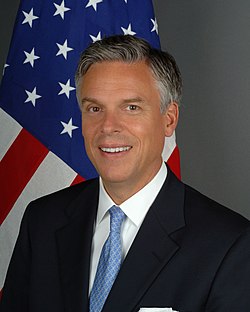
--Eventually, all powerful Mormon men (the ones who've been inducted into the vampire blood cult) start to look alike. Observe Mittens versus Jon Huntsman, who missed out on the nomination because he didn't have as many vampire-gold vaults. Two hundred years and he'll be ready to contend.

OBJECTIONS
The most obvious one: maybe you know plenty of Mormons and you're very certain (HOW CERTAIN?!) they aren't vampires. Maybe you are yourself a Mormon and know more about the church than I do. Maybe--and this is crazy--maybe you don't even believe in vampires. If any of these things are the case, then please accept my apologies as the proprietor of this Laughing Establishment. Please don't post indignant or offended comments, unless you are also forwarding this story to your entire LDS church and creating a flashpoint of condemnation. That would be fine, because angry Mormon traffic is preferable to guys in Finland searching for pictures of I Need Money, or large numbers of people searching for "tits."
Anyway, if you're really super-offended, just do what Mitt Romney did when it turned out three years' worth of his business record would impede his political future: go back in time and retro-actively NOT read this post.
DENOUEMENT
Mormon men are vampires the end.
Friday, June 29, 2012
Movie Pitch: "Martin Luther"
 | |
| Pew pew, mah brothuhs and sistuhs. |
Working Title: "Martin Luther"
 |
| Oh hey, it's Stringer Bell! |
One-sentence synopsis: The Reverend Doctor Martin Luther King, Jr. goes back in time to fight the Civil War.
Character List With Ideal Actors, in order of appearance:
MARTIN LUTHER KING: Idris Elba (perfect mix of gravitas and action-hero believability. Also, being English, his Mississippi-inflected public speaking will be amazing)
GOD: this is the easiest, most obvious casting choice of all time. Morgan Freeman. Book it.
CAPTAIN RODERICK VAN STUNTINGWOOD, leader of a U.S. Marshal team. He's a nice fellow, but got his post through family and is so hopelessly patrician that nobody will mind when we kill him off at the end of Act 1. The part will be played by Shia LeBoeuf, who needs to play more onscreen characters who suffer violent deaths.
MUNCIE COLLINS, "CHICKEN" MACTEETERS, AND ALDO BUCADIBEPPO, three other U.S. Marshals. Muncie is a slow West Virginian, Chicken is a fast-talking Boston Mickhead, and Aldo is a wacky gregarious Italian immigrant with a penchant for circus knife tricks and fine cooking. They are a blend of ethnic and national stereotypes, particularly Aldo because I'm a sucker for ridiculous Italian people. I don't actually care who plays these guys; just nail the stereotypes and they'll be fine for comic relief.
 |
| "'Supporting Actor,' my ass." |
FOXY YOUNG WIDOW WHO TEMPTS OUR HERO: Megan Fox. She's hot, white, believable as a jezebel figure, and isn't too proud to take minor demeaning roles in big action movies about The Doings of Men. See: every single role of her career.
JOHN FITZGERALD KENNEDY: Chris Pine. He's got the looks, action-movie cred, and comedic timing. Dunno if he could pull off the strange way JFK talks, but a professional Hollywood diction coach should get us to a passable Mayor Quimby rip-off by the time shooting starts.
 |
| "And a capital evening to ALL Y'ALL." |
GENERAL NATHAN BEDFORD FORREST/VOICE OF SATAN: Benedict Cumberbatch. Ghostly-white, weird, aloof and sinister. I bet the guy would do a great Satan, and as General Forrest he'd give us the greatest/most awful English-to-Southern accent transplant since Kenneth Branaugh in "Wild Wild West." Which will come up again before this pitch is over, I promise you.
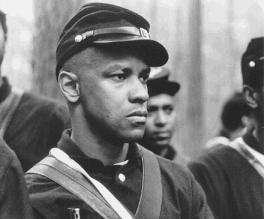
Note: You may notice I've reunited two of the three stars from Glory, the fantastic 1988 film about the Union's first all-black regiment. To that, I say: it's Morgan and Denzel. Fuck you.
Plot Outline:
We open in 1968, with a montage of contemporary TV stock footage of the King assassination. Zoom out to a shot of an actual TV playing this footage in a stark white room. MLK is watching it, as if in a dream, wearing a white suit. Looking around, he sees he's in Heaven's waiting room and realizes he's died. God enters the room and tells MLK he has a problem: Satan is intervening in the Civil War on the side of the South, by possessing General Nathan Bedford Forrest (later the founder of the KKK) and using demon magic. Before MLK can go to his eternal rest, he has to go back in time and save America from falling into darkness.
The religious angle is necessary for the integrity of MLK's character. We need to overcome MLK's famous pacifism rooted in Christian tradition: only God could ask him to own faces like this. As for Satan's influence on General Forrest, keep in mind that people in the South actually have fond feelings for the Confederacy. They're rooted in a wacky backwards-ass tribalism, but that's why it's the South. You can't portray folk heroes as tools of Satan, so we have to pick someone already renowned as an evil motherfucker. Finally, the religious angle lets us explain away time travel, gives MLK a soft landing in the past because God can hook him up, and lets God grant MLK superhuman combat powers like Denzel's character in "The Book of Eli." But God's power isn't limitless in the Satan-tainted past, so if MLK dies in the past he'll fall straight to Hell where Satan wants him for his life of adultery.
 |
| DIE |
MLK and the Marshals discover a raider camp and jump them for questioning. They learn about a large secret base where General Bedford is pursuing an important project. Before they can act on this information, the Marshals are jumped by raider reinforcements. MLK manages to escape, but his comrades are taken prisoner. Alone and wounded, he hikes through the woods looking for help. Being in Confederate Tennessee, MLK needs to avoid both the raiders and the civilians. He eventually collapses, and is taken in by a foxy white lady who's recently widowed and lives alone. MLK recovers but refuses to sleep with the white lady when she wants his business. He feels guilty about his past indiscretions, but she accuses him of being a racist and kicks him out. Wandering down the road, MLK finds a disoriented white man. Recognizing him as JFK, MLK greets him and discovers he's been sent by God as aid, and as punishment for his own life of adultery. "But you died years before me!" "God said not to ask dumb questions. He's God." The two inveterate poonhounds go off in search of the secret base.
They track some raiders to the base entrance. JFK steals a uniform and pretends to be bringing MLK in for questioning. Once inside, they sneak to the heart of the base where a giant 19th-century steampunk 'mech is being built. You read that right: a mech, a bipedal combat robot. Think the giant walking spider machine from "Wild Wild West," only slightly less ostentatious and more purposeful. MLK and JFK split up, the former going to rescue the Marshals while the latter keeps searching. JFK finds a secret Satanist ritual chamber below the mech construction pit, and learns that Satan is planning to transfer his essence from General Forrest's body into the mech itself. From there, he will have a new body to become a god on Earth and eventually dominate all of man. But JFK is caught by Forrest himself, who mortally wounds the Prince of Camelot and completes the ritual. MLK rescues his fellow Marshals, but is powerless to stop the new Satanbot from destroying the base and tromping away. MLK fights his way through the raiders to JFK, who tells him the whole plot and dies. Last words: "Ask not what your country can do for you...(cough)(retch)(grabbing MLK's lapels and pulling him close)...ask...what you can do...for your country!" BOOM. Emotional moment.

MLK explains the situation to Grant, who's naturally skeptical. The Battle of Chatanooga starts, and the Satanbot arrives. The Union forces are on the verge of all-out retreat and desertion. MLK delivers a ridiculously awesome MLK-style speech, though we probably shouldn't use any of his actual famous lines because that would be offensive (unlike, say, making Dr. King a character in your absurd Hollywood time-traveling action movie with undertones of blaxploitation). The Union soldiers charge into battle, and give MLK the time he needs to battle the Satanbot. The flaming sword is the only weapon that will damage the unholy-enchanted machine, so we're gonna have a sweet "Shadow of the Colossus"-style boss fight. MLK will have to make his way up the massive machine, slowly but surely, destroying crucial components with the flaming sword as he goes. Eventually he's able to bring the Satanbot down, but The Foe of Mankind isn't so easily vanquished! Satan appears as a shapeshifting apparition, warping between the appearances of all the people who dogged MLK from Bull Connor to James Earl Ray and eventually...HIMSELF with a violet glowing sword. (horns and strings crescendo)
Glowing sword duel ensues, and the real MLK is victorious. Falling to his knees, MLK apologizes for plowing all those skanks. God appears, though only MLK can see him, and tells him order is restored to time and space. MLK asks about JFK, who appears on cue as an angel. "I was an angel all along," he says, "I just wanted to motivate you, to help you when you needed it most." But why, MLK wants to know, did JFK go directly to Heaven while he had to endure this terrible trial?
The answer: "Because I'm Catholic, obviously." CREDITS. Skrillex.
Subscribe to:
Posts (Atom)